
What’s Changing About Change?
Feeling unmoored? You might be sensing that change itself is changing.
This reflection is part 3 of a seven-part exploration:
Becoming the Humans Our World Is Calling For:
Human Development in an Age of Acceleration
Across this series, we explore a question many people are quietly sensing:
In a time of exponential change, what kind of human development allows us to become structurally stronger under pressure?
In A Time of Transition, we explored what it means to live at a threshold ~ between worlds, between stories, between ways of being.
Here we turn to one defining feature of that threshold: The very nature of change itself. Not just that change is happening ~ but that its speed, shape, and intensity have fundamentally shifted.
This is one of the new conditions of the world we are now navigating.
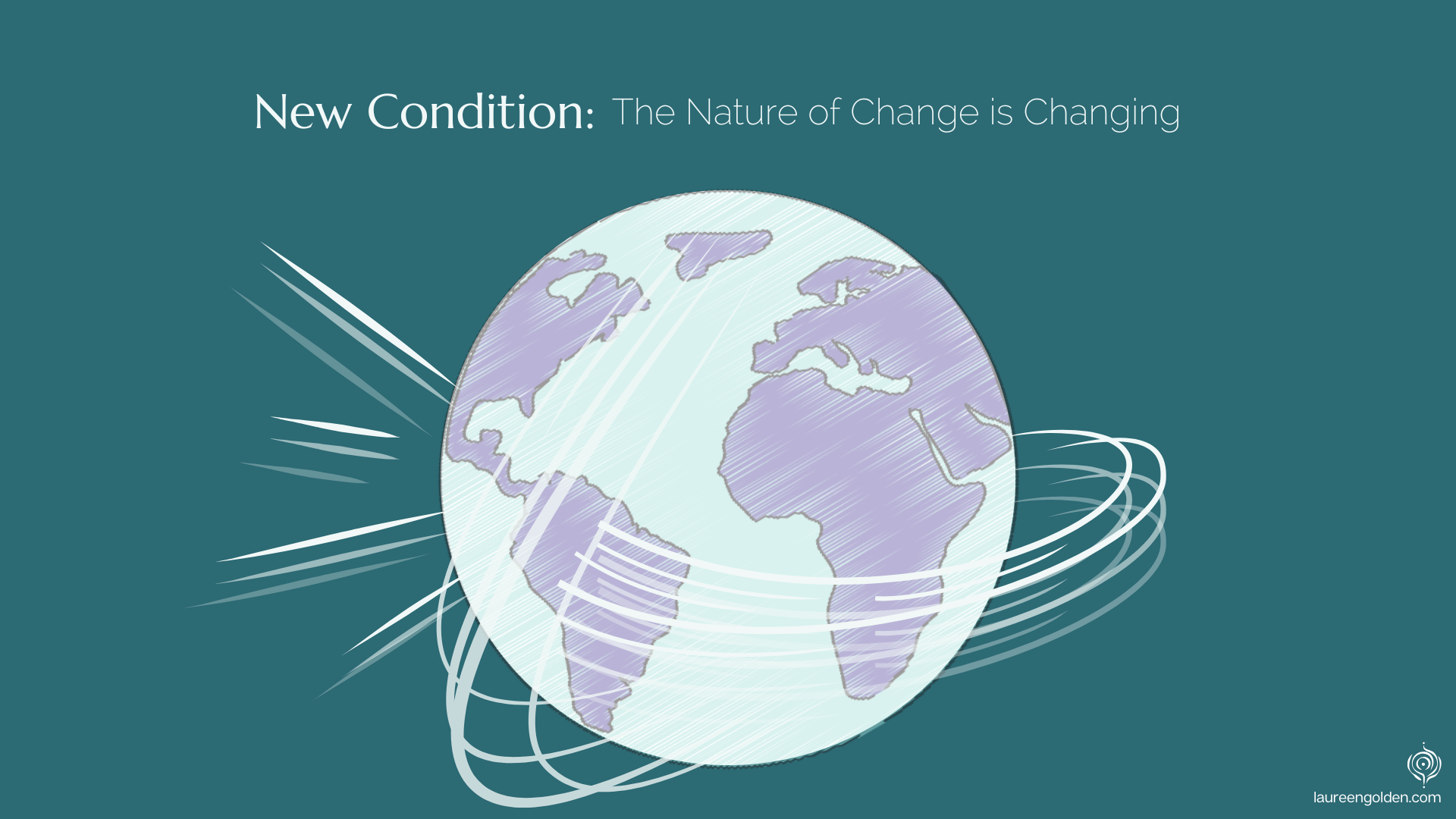
The morphing nature of external change is one of the new conditions we’re navigating.
The Nature of Change is Changing
We have always lived with change. Seasons shift. Children grow. Societies evolve. Historically, change tended to follow recognizable rhythms ~ linear or cyclical, sometimes disruptive, but largely patterned and predictable.
But now, something feels different.
Deep in our nervous systems, many of us sense it: The pace accelerating. The ground less stable. The future harder to anticipate.
It’s not simply that more is changing. It’s that the type and rate of change have shifted.
And both matter.
1. TYPE: From Patterned to Discontinuous
If change used to move like a carousel ~ rhythmic, looping, somewhat expectable ~ it now behaves more like a mechanical bull. Unsteady. Variable. Increasing in force.
“Changes are different this time: they are discontinuous and not part of a pattern.” ~Charles Handy, The Age of Unreason
We are not riding familiar waves of transition.
We are encountering disruptions without clear historical precedent.
Pandemics.
Artificial intelligence breakthroughs.
Climate destabilization.
Geopolitical volatility.
Each event reshapes the terrain before we’ve fully metabolized the last.
When change becomes discontinuous, our inherited strategies ~ built for predictable cycles ~ begin to falter.
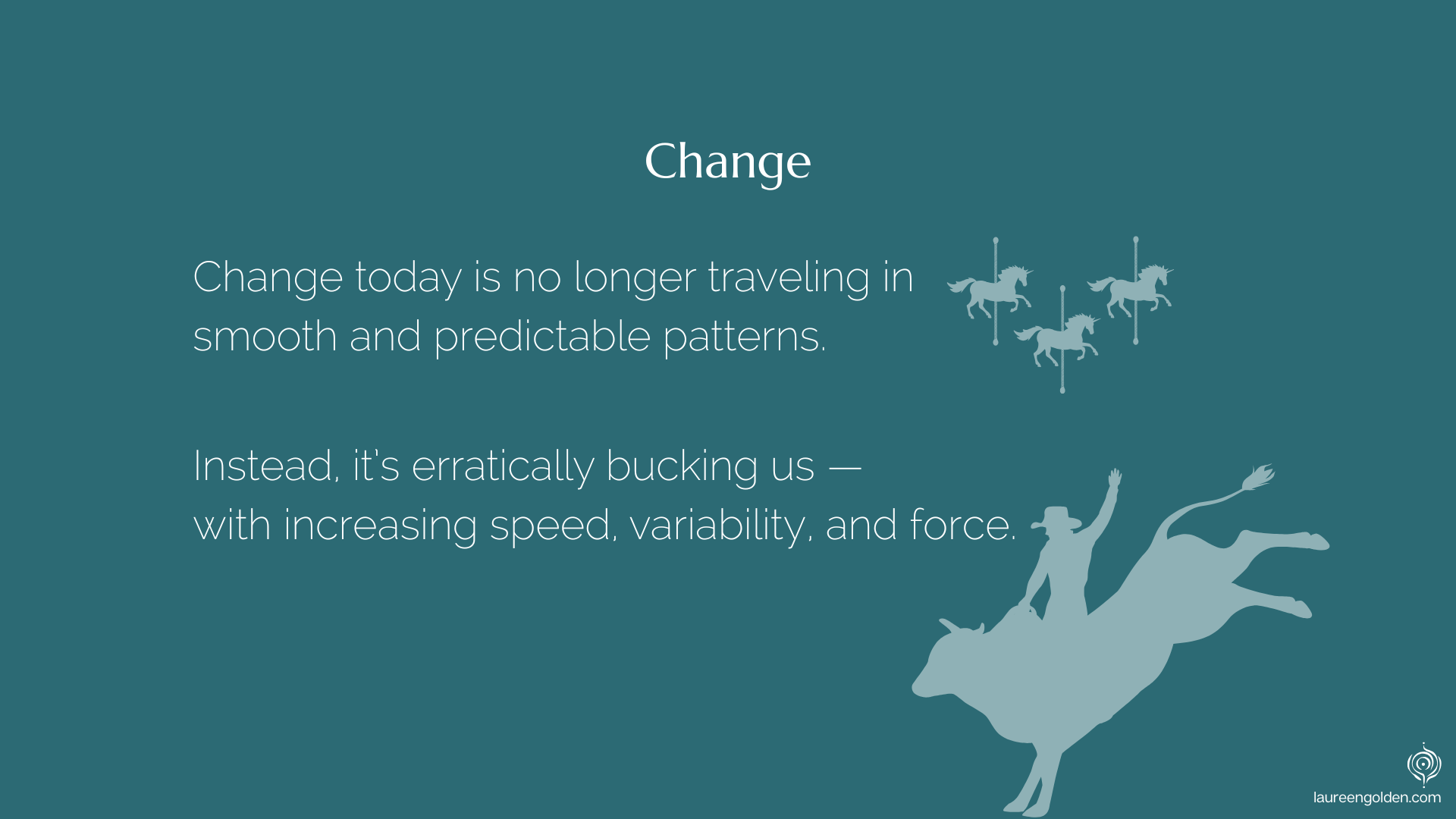
It’s easy to feel knocked off center by change that jolts us with increasing speed, force, and unpredictability.
2. RATE: From Linear to Exponential
Equally significant is the rate of change. What was once incremental is now exponential.
Exponential change is not merely “faster.” It operates according to a different logic.
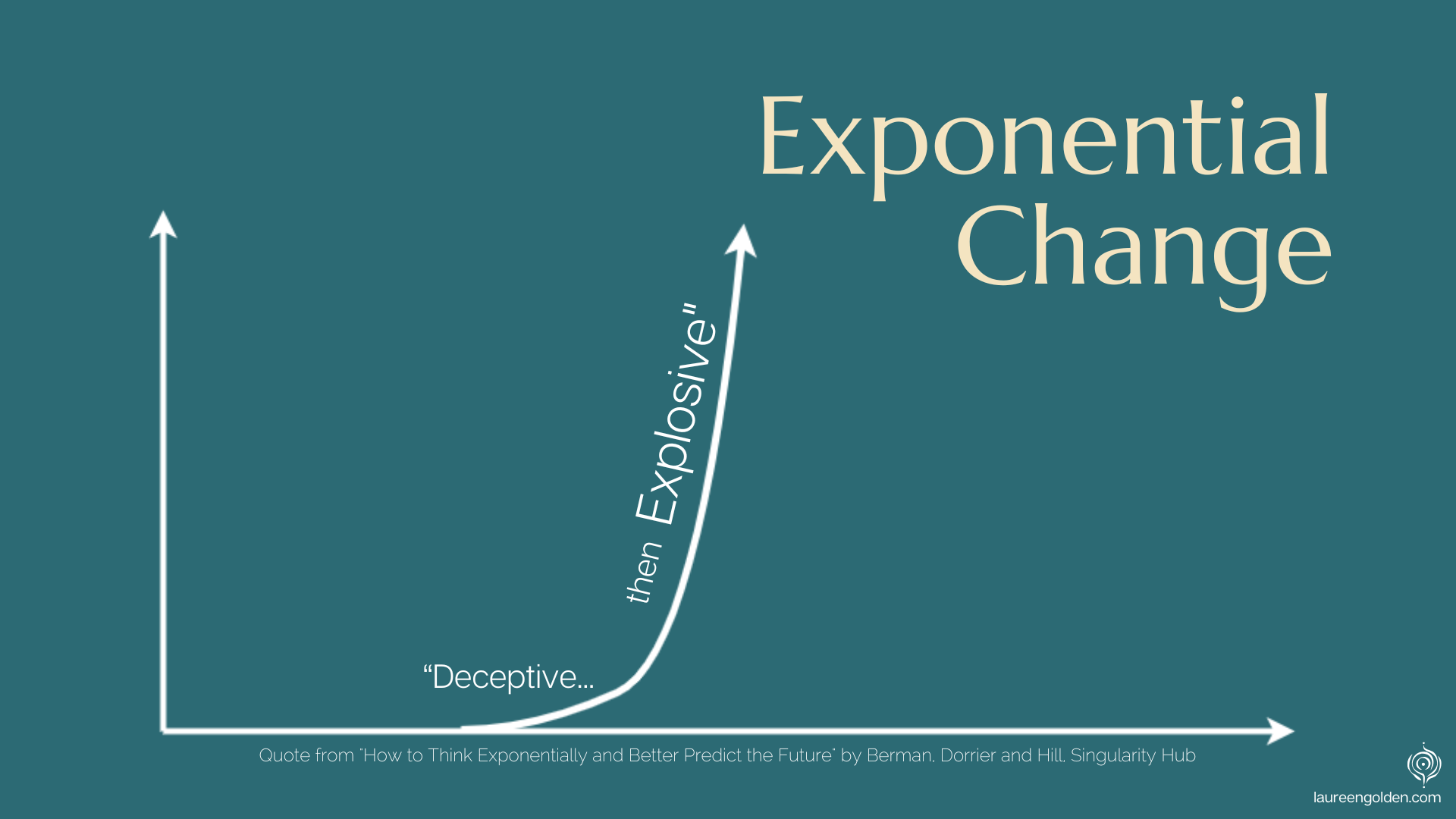
Exponential change can appear deceptive at first ~ progressing slowly, almost imperceptibly. But once it hits a tipping point, it becomes explosive, overwhelming our capacity to adapt in linear ways.
Early on, exponential patterns appear deceptively flat. Progress seems slow. Contained. Manageable.
But with each doubling ~ of data, technological capacity, ecological stress, social polarization ~ the curve steepens.
What once unfolded across decades now compresses into years. What once required adaptation across generations now demands adjustment within a single lifetime.
“Change has always been accelerating...but until recently [it] has been slow enough to enable people to adapt.” ~Ackoff, Ackoff’s Best
The challenge is not simply speed. It is compression. The time between disruption and required response is shrinking. And our internal systems — biological, psychological, organizational ~ were shaped in a slower era.
[For those who want to dive deeper in understanding the compression of time and tremendous acceleration of change, you might enjoy this 3 minute video illuminating the thinking of Dee Hock (founder of Visa) who draws from the insights of futurist James Burke.]
Why This Matters
When the type and rate of change shift simultaneously, overwhelm becomes predictable.
Systems built for robustness ~ designed to withstand disturbance ~ struggle under conditions of constant discontinuity.
Without a broader frame, we personalize the strain. Why can’t I keep up? Why does this feel so destabilizing? What’s wrong with us?
But this is not a failure of character. It reflects a culture that trained us to analyze parts ~ while leaving our capacity to perceive context underdeveloped.
When we do not name the shift in conditions, we default to survival strategies: Fight. Flight. Freeze. Fawn.
We double down on methods designed for a different terrain. We cling to linear plans in nonlinear reality.
Naming the context does not eliminate difficulty. But it restores agency. Because once we recognize that the terrain has changed, we can stop trying to navigate it with outdated maps.
A Different Response Is Required
This moment calls for something more than grit. It calls for expanded capacity ~ the ability to metabolize complexity without fragmenting internally. To widen our window of tolerance. To increase coherence under pressure. To stay present with uncertainty without collapsing into reactivity.
If change has become exponential and discontinuous, then our adaptation must evolve accordingly. Not by moving faster. But by becoming more integrative. More reflective. More developmentally mature.
This is not only a technological moment. It is a human one.
Stepping Back to See Clearly
So what’s changing about change?
It is no longer primarily linear or cyclical. It is exponential and disruptive.
It is not simply a change of scenery. It is a change of terrain.
It is not just more change. It is a new kind of change.
Which means the way we plan, lead, relate, and learn must evolve.
The strain many of us feel is not imaginary. It is informational. And when we begin to track context accurately, a new question emerges:
If the external world is accelerating exponentially,
what must evolve internally to meet it?
That widening gap ~ between outer speed and inner readiness ~ is where we turn next.
Pause here. Notice how this lands in your body.
Where do you feel the compression of time?
Where do old strategies feel insufficient?
We are not alone in sensing this shift. And we are not powerless within it. Understanding the terrain is the first step toward navigating it wisely.
🌿🍄
This reflection is one step in
a larger developmental journey.
Becoming the Humans Our World Is Calling For:
Human Development in an Age of Acceleration
Together these essays explore how human beings and social systems can
strengthen our inner integrity in a world of accelerating change.
If something in this piece resonated, you may wish to explore the wider arc of the series:
If You’re Navigating Rapid Change
If you’re a leader recognizing that old maps no longer match the terrain ~ and you’re seeking steadier footing amid accelerating conditions ~ I work alongside individuals and organizations in moments like these.
My role is not to impose solutions, but to help clarify the developmental edge, strengthen coherence under pressure, and discern what kind of support will serve the next phase of evolution.
If this resonates, I’d welcome a conversation.