
The Rift
When External Acceleration Outpaces Inner Evolution
This reflection is part 4 of a seven-part exploration:
Becoming the Humans Our World Is Calling For:
Human Development in an Age of Acceleration
Across this series, we explore a question many people are quietly sensing:
In a time of exponential change, what kind of human development allows us to become structurally stronger under pressure?
In A Time of Transition, we named the epochal threshold we are living inside.
In What’s Changing About Change?, we explored how the nature of change itself has shifted ~ becoming exponential, discontinuous, and increasingly destabilizing.
Here, we turn toward something more intimate. Not just what is happening around us ~ but what it is doing within us.
Many are sensing it before they have language for it: A widening gap between the accelerating pace of external change and our individual, collective, and systemic capacity to metabolize it.
I call this widening gap The Rift.
It’s Not Personal Failure
Across contexts and continents, people are quietly asking: “Why can’t I keep up?” “Why does everything feel like too much?” “Am I the only one who’s falling behind?”
Burnout. Anxiety. Numbness. Despair. Not isolated ~ but patterned. Experienced by many. Teachers. Executives. Teenagers. Caregivers. Elders.
When symptoms emerge at scale, we are no longer looking at individual fragility. We are looking at shared conditions.
The Rift reframes distress not as dysfunction ~ but as signal. Not as weakness ~ but as structural mismatch.
What Is The Rift?
We are living through a structural divergence.
Many external systems ~ technological, economic, ecological, informational ~ are evolving exponentially.
Internal systems ~ learning, identity formation, nervous system regulation, institutional adaptation ~ are evolving far more slowly.
For most of human history, outer and inner change moved in rhythm. We discovered new technologies ~ fire, farming, factories ~ and those innovations changed what it meant to be human. But the pace of those changes allowed for integration. Our inner worlds had time to stretch, metabolize, and adapt to the shifts around us.
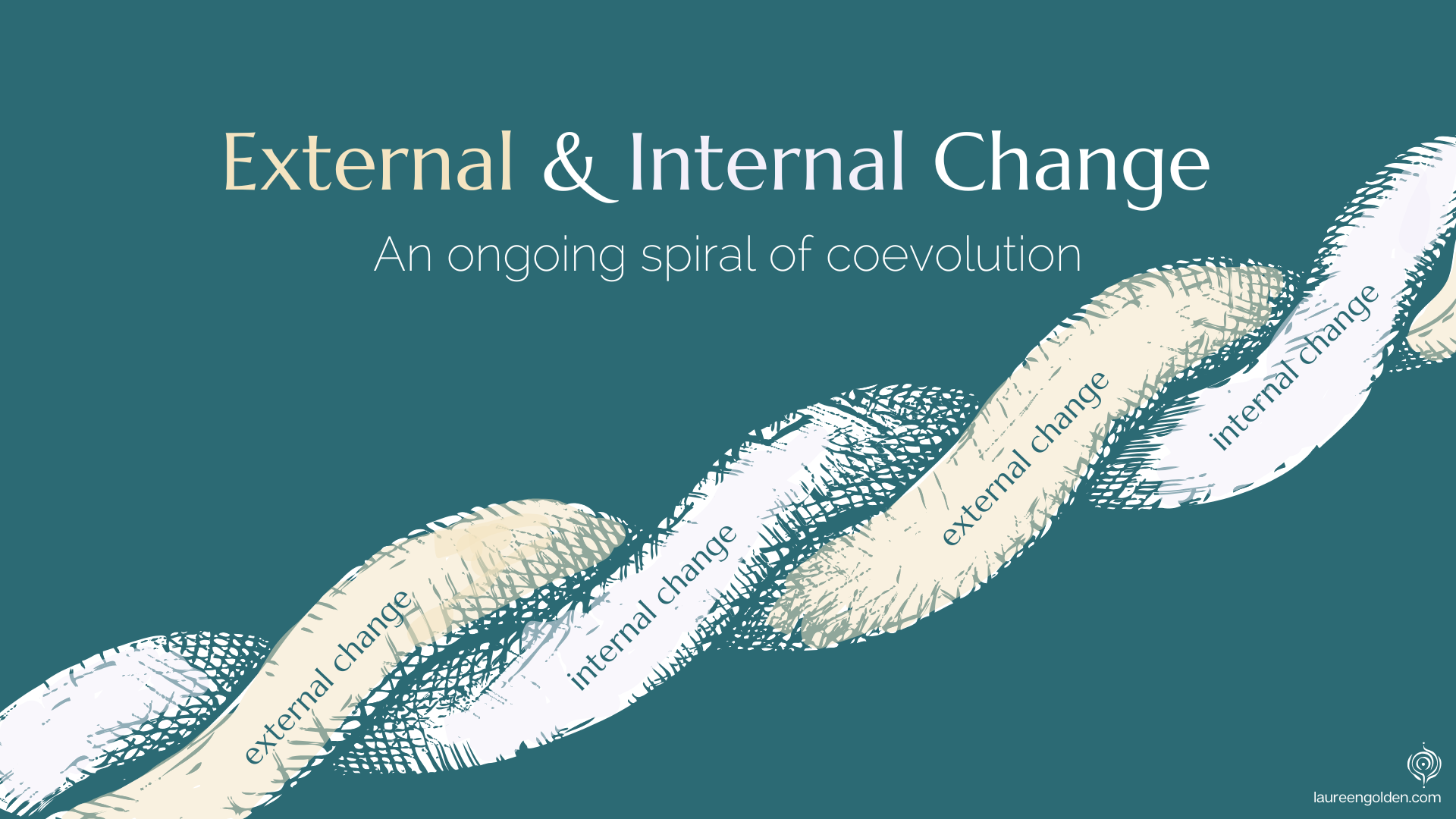
For most of history, humans and our world evolved in rhythm. With each new tool, what it meant to be human shifted…and we had time to respond.
That rhythm has fractured. As futurist Ray Kurzweil and others have noted, we’ve hit an inflection point: external change has become exponential.
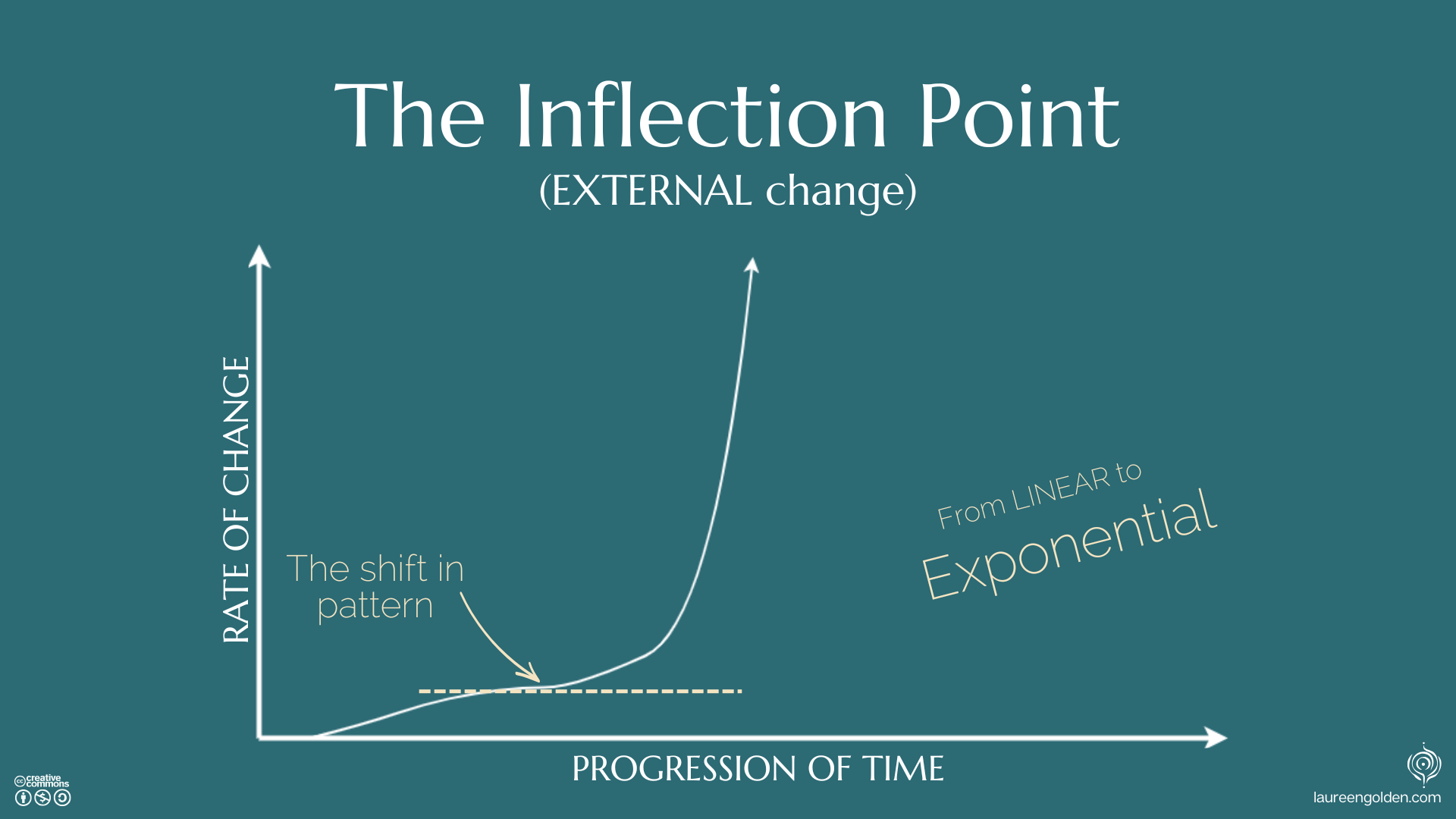
A historic shift: when external change leapt from linear to exponential…outpacing our inner systems and reshaping the human condition.
External change has accelerated beyond the inner scaffolding we developed to hold it. The widening gap between what we are setting in motion externally and our capacity to metabolize it internally ~ that is The Rift.
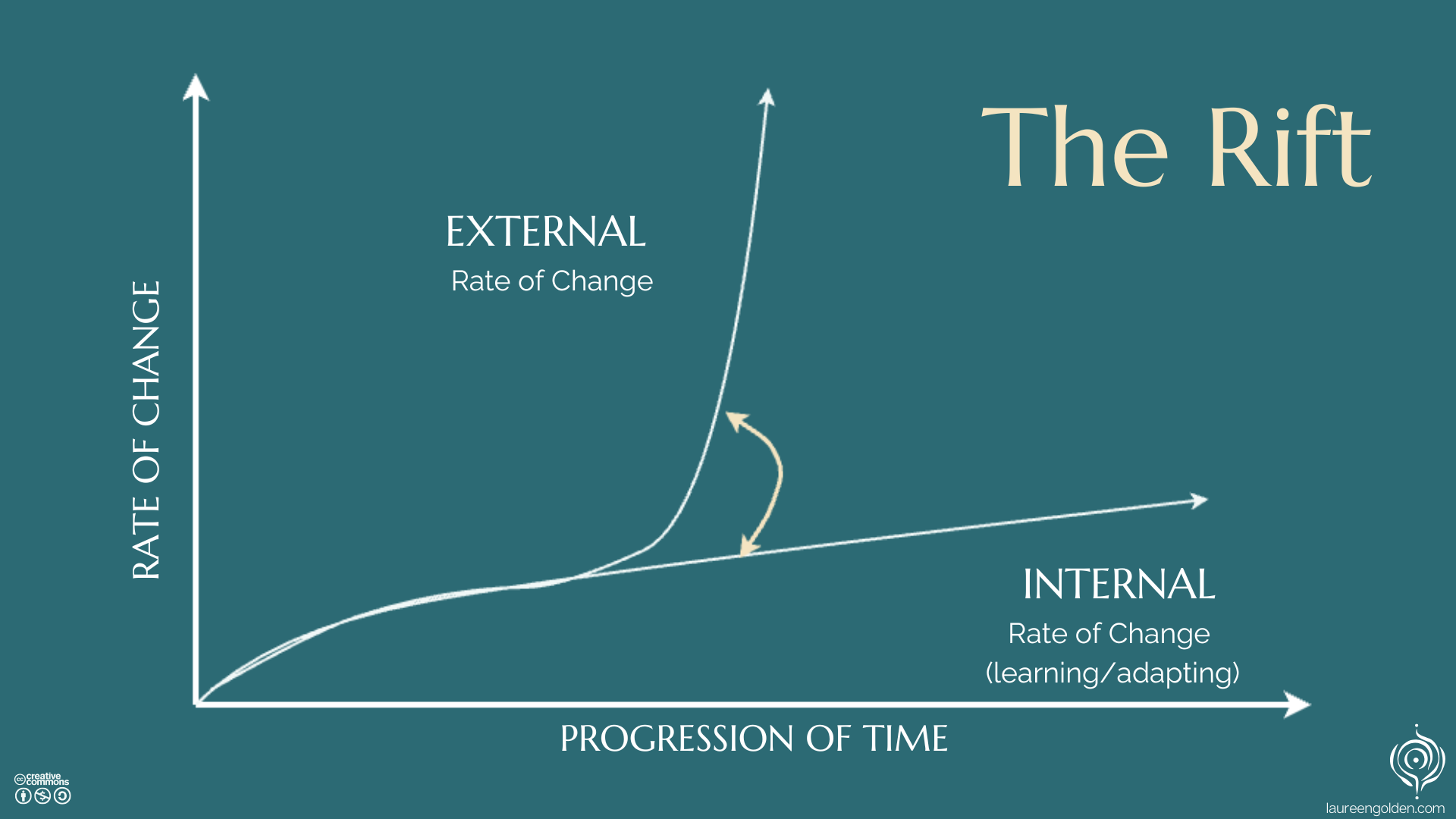
The Rift is the growing gap between accelerating external change and our slower-growing internal capacity to navigate it. This gap isn’t just theoretical . It’s somatic.
The Rift is not abstract. It’s somatic. It’s systemic. It lives in our nervous systems. In organizations. In family systems. In institutions straining under complexity they were not designed to carry.
Overwhelm, in this context, is not pathology.
It is a structural outcome of diverging curves.
A Flow Breakdown at Civilizational Scale
Psychologist Mihaly Csikszentmihalyi described “flow” as the dynamic balance between challenge and skill.
High challenge + low skill → anxiety
Low challenge + high skill → boredom
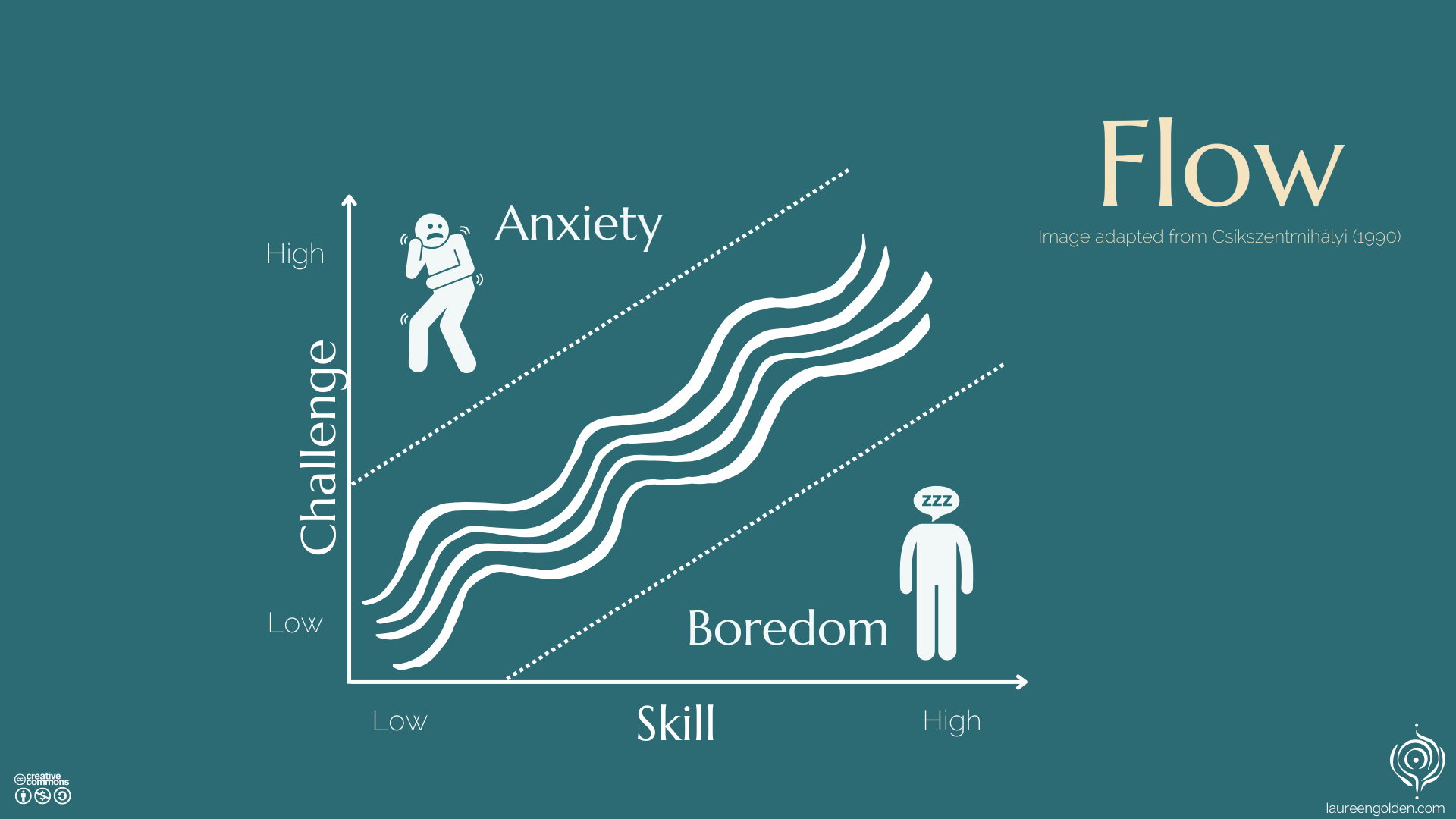
Flow is a dance between challenge and skill. When the music of the world speeds up ~ and we haven’t learned the steps ~ we stumble into overwhelm.
For most of modern history, challenge in our civilization expanded at a pace that allowed skill to grow in response.
We are no longer in that rhythm. When exponential challenge meets linear capacity, anxiety is not a character flaw. It is math.
Without new forms of internal scaffolding, the Rift continues to widen ~ and anxiety increases.
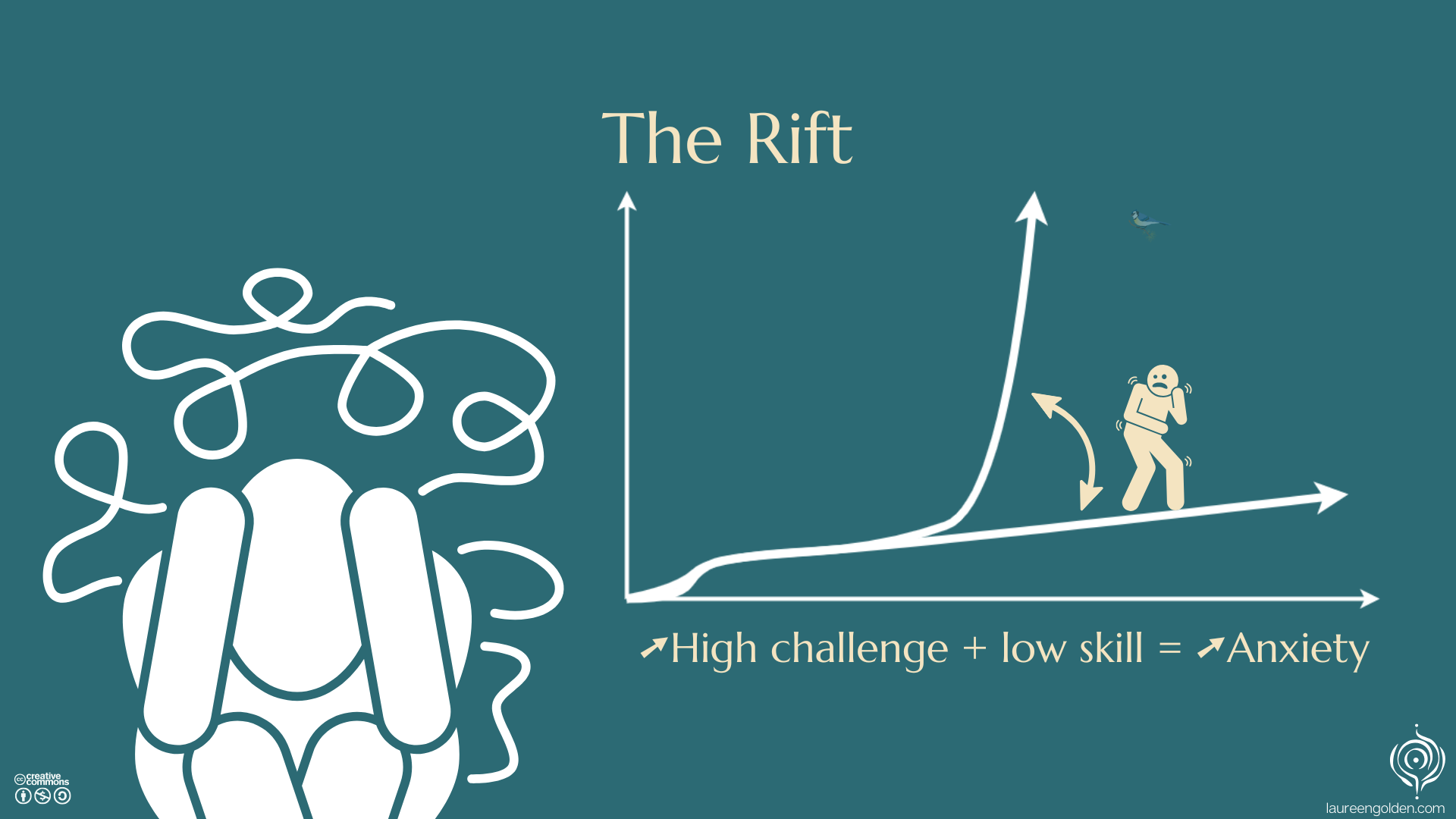
When challenge outpaces capacity, we fall out of flow and into overwhelm. Without new scaffolding, the Rift will continue to widen.
Signals, Not Symptoms
What if anxiety, burnout, and despair are not signs that we are broken ~ but signals that our developmental pace has not caught up to our technological reach?
What if our nervous systems are responding intelligently to conditions they were never prepared to meet?
When we pathologize the pain, we shrink the frame. When we contextualize it, we recover agency.
This is not to erase trauma, inequity, privilege, or history. The Rift moves differently through different histories, bodies, and communities. But naming it allows us to stop asking: What is wrong with me? And begin asking: What is this moment asking of us?
The Doorway Inside the Gap
The Rift is destabilizing. But it is also diagnostic.
It reveals the core developmental task of our time:
If external change has gone exponential,
internal change can no longer remain linear.
We are being asked ~ individually and collectively ~ to evolve our capacity to learn, integrate, and reorganize at greater depth and speed. Not to hustle harder. But to grow differently.
Works Referenced
[1] Ray Kurzweil, The Law of Accelerating Returns. 2001
[2] Mihaly Csikszentmihalyi. Flow: The Psychology of Optimal Experience.
🌿🍄
This reflection is one step in
a larger developmental journey.
Becoming the Humans Our World Is Calling For:
Human Development in an Age of Acceleration
Together these essays explore how human beings and social systems can
strengthen our inner integrity in a world of accelerating change.
If something in this piece resonated, you may wish to explore the wider arc of the series:
If You’re Feeling the Gap
If you’re sensing the widening space between what’s being asked of you and what you feel resourced to meet — you are not alone. Moments like this require more than endurance. They require new forms of internal scaffolding and collective coherence.
I partner with leaders and organizations navigating accelerating complexity ~ helping them clarify their developmental edge, strengthen capacity under pressure, and discern what kind of support will serve the next phase of evolution.
If this resonates, I’d welcome a conversation.