
Transformative Social Systems
Restoring Integrity in a Fragmented World
This reflection is part 7 of a seven-part exploration:
Becoming the Humans Our World Is Calling For:
Human Development in an Age of Acceleration
Across this series, we explore a question many people are quietly sensing:
In a time of exponential change, what kind of human development allows us to become structurally stronger under pressure?
From within the Void, what begins to stir is not innovation for its own sake. It is a return to the conditions human beings have always required in order to develop ~ relationship, shared reality, meaningful feedback, and the capacity to grieve.
We have known these conditions before. Even if we have forgotten how to cultivate them.
From Fragmentation to Integrity
If you have felt the strain of trying to develop within environments designed for control, optimization, or performance, your struggle makes sense. Human beings do not resist development. We resist conditions that fragment us.
For generations, many of our core institutions ~ schools, workplaces, civic systems ~ were designed for robustness and predictability in a slower era. They were built to produce stability, obedience, and efficiency. And in many ways, they succeeded.
But robustness is not the same as integrity.
Robust systems can withstand force for a time. They absorb pressure. They reinforce their walls. They endure for extended periods of time ~ but their strength can mask underlying brittleness.
Integrity is different.
Integrity is the capacity to remain coherent under pressure ~ to metabolize disruption without fragmenting, to face reality without denial, to stay connected without collapsing into reactivity. It feels like steadiness in the midst of strain. Like not having to split in order to survive the moment.
When environments prioritize performance over presence, compliance over inquiry, and speed over integration, essential elements begin to erode. The drive to learn narrows. Anxiety spreads. Shame begins to replace curiosity. Feedback feels threatening. Grief is suppressed.
Over time, the very conditions required for our development begin to feel dangerous. Truth feels risky. Vulnerability feels costly. Experimentation feels unsafe.
From the Void: An Emerging Ecosystem
The Void we named is not simply the absence of new structures. It is the absence of developmental environments intentionally designed to strengthen integrity ~ in individuals and in the systems they inhabit.
What, then, would different conditions feel like?
They would feel steady rather than urgent. Honest without humiliation. Challenging without shaming. Structured without suffocating.
In such spaces, integrity is not something performed. It is something practiced.
Transformative Social Systems (TSS) is one articulation of this emerging pattern. Not a single program. Not a branded solution. But a family of practices and design principles oriented toward restoring systemic integrity. Transformative Social Systems are intentionally curated environments where people develop the capacity to meet the complexity of our times.
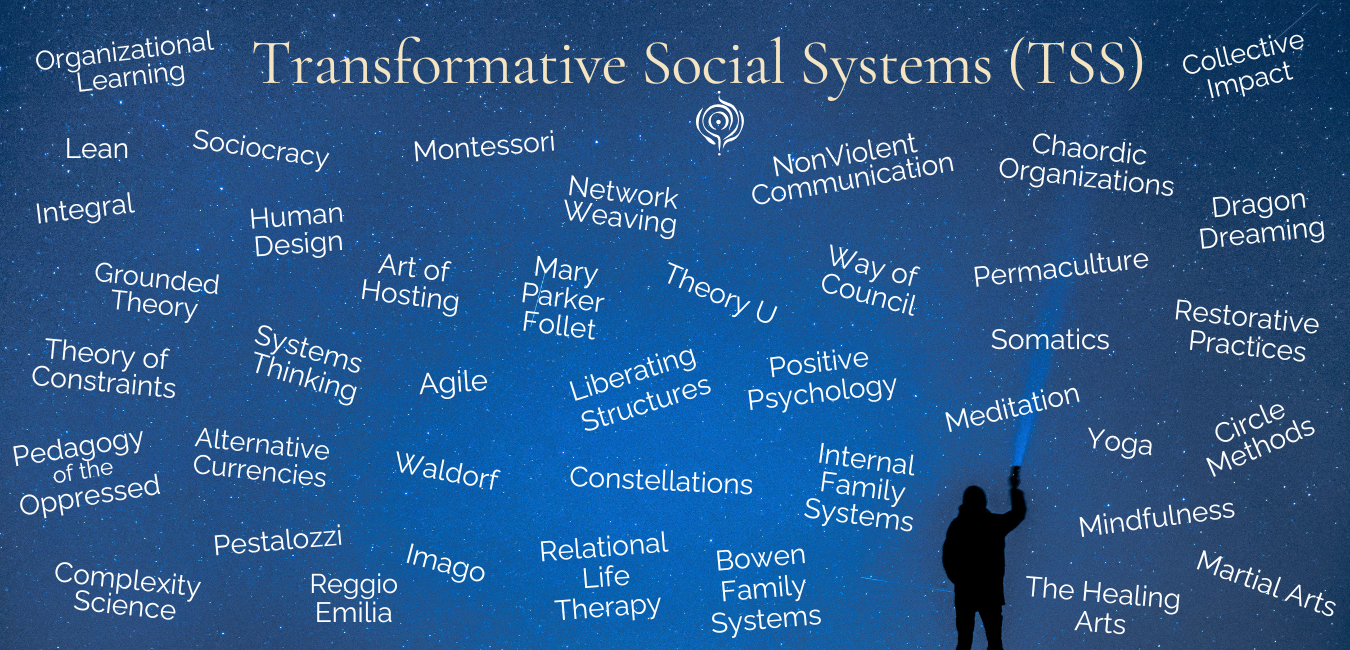
Transformative Social Systems (TSS) names a constellation of practices ~ ancient and modern ~ oriented toward restoring systemic integrity.
Together, they form a living ecosystem ~ cultivating conditions for coherence, learning, and wholeness under pressure.
Transformative Social Systems begins with a simple premise: development in complexity unfolds within prepared environments stewarded by prepared leaders.
Restoring Wholeness
When the conditions are right, learning deepens naturally. Differentiation strengthens. People become more able to face reality together. Systems regain the capacity to metabolize disruption without fragmenting under pressure.
This is not about inventing a new kind of human. It is about recovering our capacity for integrity.
It is about re-membering what was fragmented ~ reuniting learning with living, work with development, power with love, autonomy with belonging.
Transformative social ecosystems are not utopian. They are intentional. They require thoughtful design, skilled facilitation, and adults willing to practice remaining coherent under pressure.
But they are possible. They already exist in pockets ~ in TSS communities of practice, in organizations willing to prioritize wholeness over speed, in learning spaces that value transformation over performance.
They feel less like innovation and more like oxygen.
Looking Forward
When people develop within these conditions, something quiet but powerful happens. They become less reactive. More coherent. More capable of holding complexity without splintering.
And from that integrity, participation changes. Not because it is demanded. But because it naturally unfolds.
The invitation of our times is not to heroically fix broken systems from the outside. It is to cultivate environments where human beings can restore integrity together ~ and trust that from such wholeness, wiser forms of participation will emerge.
The Void is fertile. What grows next will depend on the conditions we choose to cultivate. For now, it may be enough to recognize: fragmentation makes sense. And integrity is possible ~ under the right conditions.
A Living Lineage
The concept we now refer to “Transformative Social Systems” did not arise from a single mind. It emerged over years of shared inquiry within a wider field of practitioners exploring how learning, change, and human development unfold in relationship.
I’m deeply grateful for Pascale Mompoint-Gaillard, with whom I co-authored the foundational white paper that gave language to this family of practices and named it Transformative Social Systems. That paper marked a moment of articulation ~ and the ideas continue to evolve within the living field from which they came. This piece is one expression within that ongoing unfolding.
🌿
This reflection is one step in
a larger developmental journey.
Becoming the Humans Our World Is Calling For:
Human Development in an Age of Acceleration
Together these essays explore how human beings and social systems can
strengthen our inner integrity in a world of accelerating change.
If something in this piece resonated, you may wish to explore the wider arc of the series:
If You’re Feeling the Strain of Fragmentation
If you’re recognizing the quiet toll of holding complexity in systems that feel internally scattered and externally brittle ~ you’re not alone. This moment is not simply asking for endurance. It is asking for environments that strengthen integrity rather than erode it.
I partner with leaders and organizations navigating accelerating complexity ~ helping them clarify their developmental edge, strengthen coherence under pressure, and discern what kind of support will serve the next phase of evolution.
My role is not to impose solutions, but to help clarify the developmental edge, strengthen coherence under pressure, and discern what kind of support will serve the next phase of evolution.
If this resonates, I’d welcome a conversation.